• Productivity • Study •9 min read


• Productivity • Study •9 min read
That moment when you finally sit down to work and suddenly feel the urge to “just check” your phone? That’s not laziness. That’s relief-seeking. Your brain senses discomfort – stress, uncertainty, fear of messing up and it reaches for the fastest escape hatch it knows: a quick hit of dopamine. One scroll turns into ten. One “I’ll start in five minutes” turns into tomorrow. And the worst part is you do care… which is exactly why it’s so hard to start.
Here’s the bottom line: you don’t need more willpower – you need a setup that makes starting easier and quitting harder. When the first step feels small, when distractions aren’t one tap away, and when your environment is built to protect your focus, procrastination loses its grip.
Because your brain isn’t the enemy. It’s just running the wrong safety program. And once you understand that, you can outsmart it.
For a long time, the common assumption was that people who put things off were just lazy or lacked ambition. Modern science tells a much more sympathetic story. Researchers at the University of Sheffield have found that procrastination is essentially a struggle with mood regulation rather than a lack of time management skills.
When you sit down to tackle a daunting task, your amygdala, the almond-shaped part of the brain responsible for processing emotions and detecting threats, gets triggered. It doesn’t distinguish between a physical threat and the psychological stress of a difficult project. To your brain, that complex spreadsheet or intimidating essay looks like a predator.
To protect you from this perceived threat and make you feel better in the immediate moment, your brain directs you toward a quick hit of dopamine. This is why you suddenly feel an uncontrollable urge to check your Instagram feed or fall down a Wikipedia rabbit hole. You aren’t avoiding the work; you are avoiding the negative feelings associated with the work.
This internal tug-of-war is deeply rooted in our evolutionary biology. Humans are wired to prioritize immediate rewards over long-term gains, a concept known as hyperbolic discounting.
In your mind, there are two versions of you competing for control:
The problem is that your brain often treats your future self like a complete stranger. When you procrastinate, you are essentially offloading your stress onto someone else, even though that someone is still you. Bridging this gap requires more than just grit. It requires creating a physical environment where your present self has no choice but to align with your future goals.
Think of your brain like an old car engine on a freezing morning. The hardest part is the ignition. In chemistry, this is called activation energy – the minimum amount of energy required to start a reaction. To lower that energy, tell yourself you are only going to work for five minutes.
Once you start, the Zeigarnik Effect takes over. This is a psychological phenomenon where our brains experience a cognitive tension when a task is left unfinished. We naturally want to see things through to the end. By committing to just five minutes, you bypass the amygdala’s fear response, and usually, by the time the five minutes are up, the urge to quit has vanished.
Since we know procrastination is a search for immediate dopamine, the most logical solution is to make that dopamine harder to get. Relying on your own willpower is a losing battle because every time you resist the urge to check your phone, you drain your “battery.”
This is where apps for procrastination like AppBlock become your best teammate. By setting up a Strict Mode profile, you aren’t just trying to stay off social media; you are physically removing the option. When your brain realizes that the emergency exit to TikTok or YouTube is locked, it eventually stops looking for it. This forced boredom redirects your focus back to the only thing left to do: your work. It’s the ultimate way to protect your Future Self from the impulsive whims of your Present Self.
This sounds counterintuitive, but being hard on yourself actually makes you procrastinate more. A study on college students found that those who forgave themselves for procrastinating on their first exam performed significantly better on the second one.
Why? Because guilt is a negative emotion. As we’ve learned, your brain procrastinates to avoid negative emotions. If you feel guilty about wasting the morning, your brain will try to soothe that guilt by, you guessed it, distracting you with more scrolling. Break the cycle by acknowledging the slip-up, forgiving yourself, and starting fresh in the next hour.
Economist Katherine Milkman introduced the idea of temptation bundling, which is basically pairing a task you dread with something you love. The science here is simple: you’re using a high-frequency behavior to reinforce a low-frequency one.
Maybe you only listen to your favorite true-crime podcast while you’re doing data entry, or you only treat yourself to that specific expensive coffee while you’re writing your weekly report. By tethering a “want” to a “should,” you decrease the emotional friction of starting the difficult task.
Ambiguity is the best friend of procrastination. When a task is vague, like “Work on Marketing Project,” your brain can’t visualize the first step, so it feels overwhelmed and shuts down.
Instead, use Micro-Steps. Your goal shouldn’t be to finish the project, it should be to open the document and write the first three sentences. These tiny, concrete actions provide small wins that trigger a steady stream of dopamine, keeping you motivated to take the next step without the paralyzing fear of a massive deadline.
We live in an attention economy where billions of dollars are spent to keep you clicking. Fighting that with just grit is like bringing a knife to a gunfight.
Nope. Lazy people don’t care about the task. Procrastinators usually care too much, which creates the anxiety that leads to avoidance.
That’s when you clean your whole house to avoid writing a report. It feels like work, but it’s still avoidance. Recognize it for what it is: a sophisticated trap. Use a timer to force yourself back to the one thing that actually matters.
Yes. By adding a physical barrier between you and your distraction, you break the “automatic” habit of checking your phone. AppBlock acts as the external discipline your brain is currently struggling to find.
You don’t need more motivation, you need a better environment. Stop fighting your brain and start outsmarting it. Because your future self will definitely thank you for the extra free time you’re about to create.
Gain back control over your screen, empower your life with AppBlock.
Try for free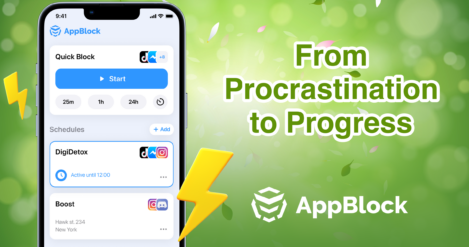
April is a month of renewal, growth, and reinvigoration, but it can also be a time when productivity wanes due to various distractions and c...

As the school year kicks off, students across the globe are once again faced with the challenge of balancing academic success with the endless distractions…

Quick answer How do I block websites on Android? Android doesn’t offer a built-in way to block specific websites across the system.