• Productivity •14 min read


• Productivity •14 min read
To really boost productivity, it helps to move past the old industrial idea that more hours automatically means more output. A more modern approach is about managing mental energy and protecting focus so it can be used where it counts. The biggest productivity wins usually come from working with natural daily rhythms, prioritizing what matters most with simple frameworks, and using AppBlock to cut out digital distractions before they steal attention.
The modern day often feels like a losing battle against a relentless tide of pings, notifications, and “urgent” requests that treat your attention as an infinite resource. However, science is clear: the brain cannot multitask. It can only task-switch. Every time you glance at a notification during a deep-work session, you leave behind something called attention residue.
It takes an average of 23 minutes and 15 seconds to return to a state of flow after a single interruption. A few quick email checks can cut overall efficiency by up to 40% before lunch. That is not just lost time—it is a drained prefrontal cortex and a brain that feels cooked by mid-afternoon.
Most productivity advice still sounds like it was written for 19th-century factory shifts, not 21st-century human brains. We tend to treat our bodies like obstacles to be overcome rather than the complex, biological systems they actually are. Realizing peak performance is rarely about iron-clad willpower or drinking that fourth espresso; it is about the strategic management of your cognitive resources and natural cycles.
When your physiology is working with you, focus becomes the path of least resistance. If you feel like you are constantly on but never actually moving the needle, you aren’t failing a character test, you are likely just fighting your own biology. Here is how to stop the tug-of-war and start designing a blueprint for high-level output.
Natural light within about 30 to 60 minutes after waking helps kick off the day’s cortisol rise. That boost supports alertness and also starts the internal countdown that influences when melatonin shows up later, which matters more for sleep than most people realize.
Your brain tends to run in roughly 90 to 120 minute waves of higher focus. Instead of forcing nonstop deep work, it’s more effective to lean into that pattern by working in focused blocks and then taking an actual break. Ideally that break means stepping away from screens so attention can reset properly.
Sleep is not just downtime, it’s the brain’s core recovery cycle. High-quality sleep supports memory consolidation and helps clear metabolic byproducts, which keeps the prefrontal cortex sharper for planning, restraint, and decision-making the next day.
Think of physical movement as maintenance for your brain. Engaging in moderate aerobic exercise, even just a brisk walk, spikes your levels of Brain-Derived Neurotrophic Factor (BDNF). This protein acts essentially like fertilizer for your mind. It is vital for keeping your neurons healthy and your synapses flexible, making it significantly easier for your brain to learn and retain complex information during a long workday.
Once your biological basics are dialed in, the next step is getting your workload organized in a way that saves mental energy. Simple, repeatable frameworks can do a lot of heavy lifting here, especially when you want to reduce decision fatigue and stay focused on what actually moves the needle.
If a task takes less than two minutes, do it immediately. This prevents small, nagging items from cluttering your mental space and creating unnecessary anxiety that lingers throughout the day. For larger, more daunting goals, use this as a gateway habit. Committing to just two minutes of a new habit, like opening a document or putting on your running shoes, makes it significantly easier to continue because you’ve already bypassed the brain’s initial resistance to effort.
This diagnostic tool forces a clear distinction between what is truly important and what is merely loud. Most people spend their lives reacting to the emergencies of others, which leads to burnout and a lack of long-term progress.
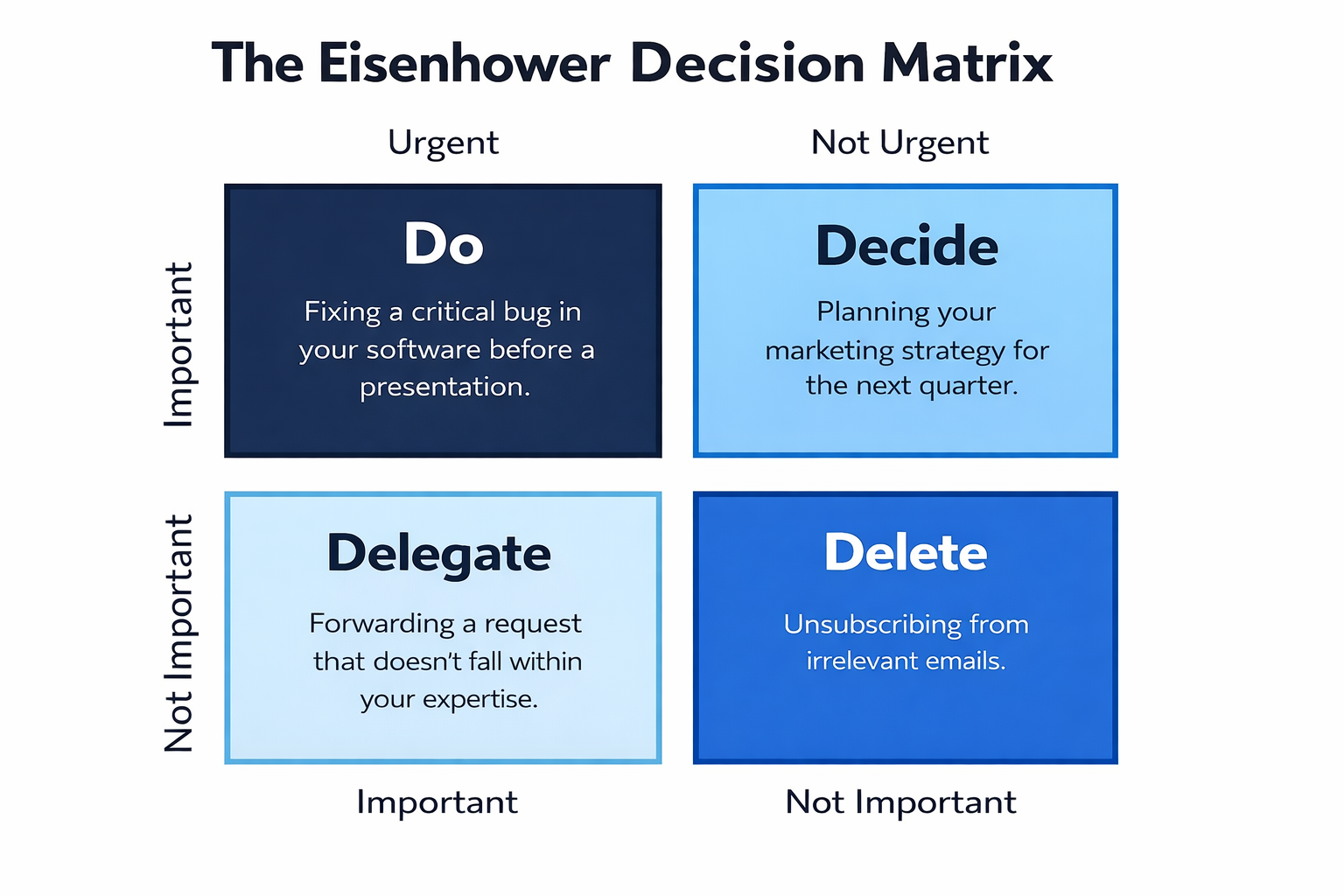
The most effective strategists spend the majority of their time in Quadrant 2. These are tasks that are vital for long-term goals, like skill-building, networking, or deep planning—but aren’t yet urgent. By focusing here, you prevent future crises from ever happening and ensure that your daily actions actually align with your bigger ambitions.
Tackle your most difficult, high-value task first thing in the morning when your cognitive resources and dopamine levels are at their peak. This prevents the mental weight of a looming task from draining your energy as the day progresses. By finishing the hardest task early, you remove the shadow of procrastination and gain a massive psychological win that carries you through the afternoon.
Productivity is not a flat line, it follows ultradian rhythms, which are natural cycles of high and low energy that typically last between 90 and 120 minutes. Research indicates that in a creative, flow state, the mind works optimally for only about 90 minutes to two hours before requiring a period of rest to avoid burnout. In fact, even the most elite performers typically hit a ceiling of roughly four hours of high-intensity, sustainable “deep work” per day. Attempting to push through these biological limits without strategic recovery leads to cognitive fatigue, a higher error rate, and diminished creativity.
To maintain a high output throughout the afternoon, professionals and students must pivot from managing time to managing energy:
Even with a solid energy plan, the brain will go hunting for a quick dopamine hit the moment the battery dips. When fatigue shows up, willpower is usually the first thing to clock out, and that harmless one-minute scroll suddenly feels weirdly necessary.
This is where environment design beats self-control every time. AppBlock works like a digital guardrail that quietly carries the discipline for you. With Schedules, boundaries can run on autopilot, like blocking social and news apps from 9:00 AM to 5:00 PM, and Strict Mode helps keep those rules in place when afternoon motivation gets slippery.
Think of it as outsourcing blocking the way the Eisenhower Matrix outsources decisions: it pushes distractions into the third quadrant by default, not important, not worth attention right now. The result is simple: 90-minute work blocks stay clean, breaks become real recovery, and there’s still focus left in the tank at the end of the day.
Use this list as a daily focus checklist. Pick 2–3 habits, lock them in for a week, then stack the next. For distraction-proof deep work, automate your boundaries with AppBlock so your focus blocks stay uninterrupted.
| Action / Method | Key Benefit & Mechanism |
|---|---|
| Morning sunlight | Get natural light within 30–60 minutes of waking to set your body clock (cortisol up now, melatonin on time later). |
| Sleep | Aim for 68–75°F and darkness to support deep sleep (recovery, memory, “brain clean-up”). |
| Movement | Aerobic exercise acts as “brain fertilizer,” and enhance neural plasticity and learning. |
| 2-Minute Rule | If it takes <2 minutes, do it now. For habits, start with a 2-minute version to reduce friction. |
| Eisenhower Matrix | Sort by Urgent vs. Important; prioritize Important / Not Urgent to win long-term. |
| Eat the Frog | Do your hardest high-value task first, when focus and willpower are strongest. |
| Pomodoro / time blocks | Work in timed intervals (e.g., 25 or 90 minutes) to reduce burnout and protect deep focus. |
| Ultradian rhythms | Match effort to 90–120 minute alertness cycles; take real breaks off screens to reset attention. |
| NSDR / Meditation | 10–30 minutes of Non-Sleep Deep Rest to restore calm focus and reduce mental fatigue. |
| Batching tasks | Check email/Slack in 2–3 set windows to avoid constant context switching. |
| Remove your smartphone | Even seeing your phone can drain attention, put it in another room during deep work. |
| Daytime light + room temp | Use bright overhead lighting (5000K+) and keep workspaces around 68–75°F for alertness. |
| Outsource boundaries (AppBlock) | Automate digital limits so 90-minute focus blocks stay protected from notifications and “just checking.” |
Research indicates that in a creative, flow state, the mind works optimally for about 90 minutes to 2 hours. After this window, the brain requires a period of rest to avoid burnout.
For most people, an app blocker is the highest-leverage option. And AppBlock stands out because it combines Schedules (automation) with Strict Mode (anti-bypass), so your focus plan runs even when motivation dips.
Yes. Studies suggest that 4 hours is generally the upper limit of sustainable, high-intensity cognitive labor per day. Managing your energy ensures those four hours are of the highest quality.
This is due to context switching. Rapidly shifting between tasks drains your prefrontal cortex, leading to decision fatigue and increased mental exhaustion.
Gain back control over your screen, empower your life with AppBlock.
Try for free
Maintaining focus on work is sometimes hard and sometimes harder. We get it, and it’s the reason why AppBlock ever even saw the light of…
How many people use social media? What is the most active age group on social media? And what platforms are used the most in 2024?…

Quick answer What are the best productivity apps for 2026? Real productivity starts with focus, not planning. By protecting your attention first…